The Architecture of Failure - Prologue
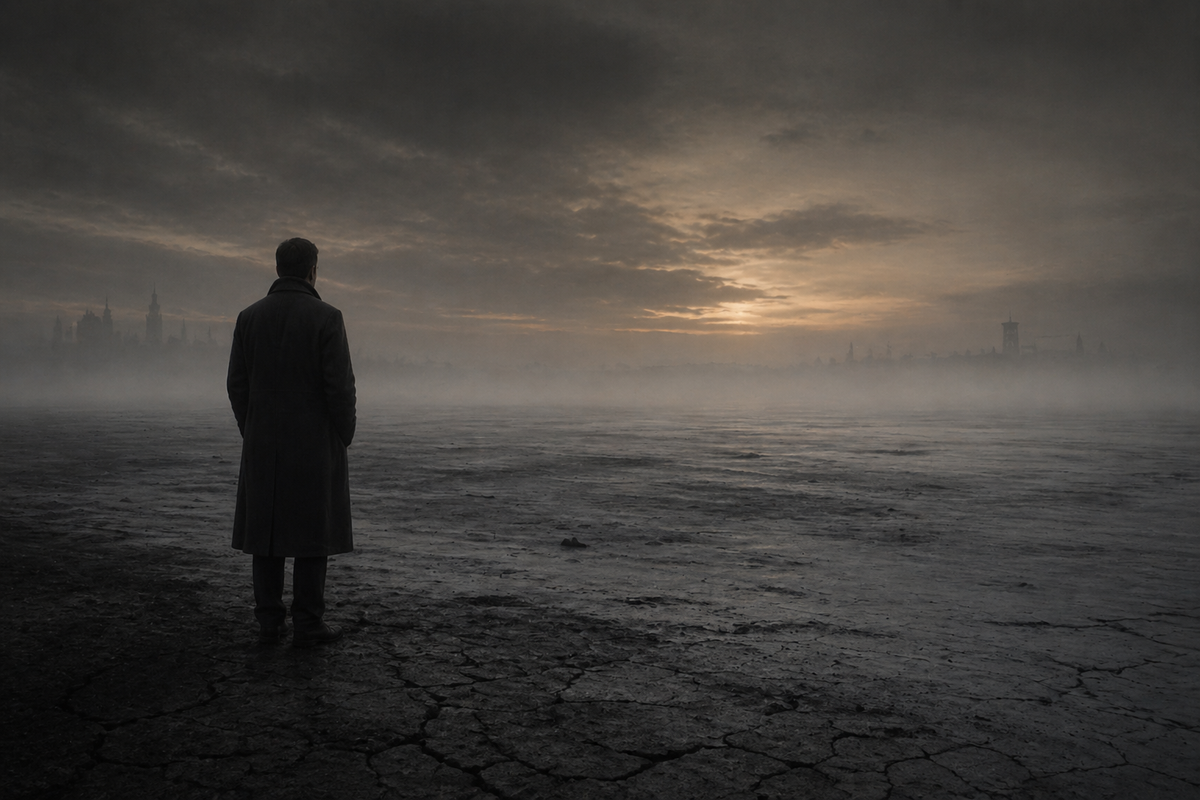
The Speech the World Rendered Insufficient
On Chaplin, Ukraine, and the gap between moral clarity and institutional reality
The Craft and the Truth
Charlie Chaplin was the most technically controlled performer of his generation. Every frame of his films was calculated — the angle of a hat, the timing of a stumble, the precise duration of a held gaze. When he appears in the final scene of The Great Dictator and delivers what has become known simply as "the speech," he is still performing. He knows the camera is there. He chose every word. The sincerity is real, and it is also constructed with complete professional mastery. The two are not contradictions: a man can mean every word he says and still know exactly how he is saying it. That control does not make the speech less true. It makes its failure more precise — because a man who understood exactly what he was doing, in full command of his craft, produced something the world rendered insufficient regardless.
He made the film over two years, 1938 to 1940, while the American government quietly discouraged the project. He financed it himself. He set it in a country his audience preferred not to think about, starring a character most of his countrymen were not yet willing to name as a monster. The film opened in October 1940. France had fallen four months earlier. The United States would not enter the war for another fourteen months. Chaplin was not speaking to a sympathetic room.
The speech begins with a diagnosis that has not aged. Greed has poisoned men's souls. Machinery that should have given us leisure has left us in want. We think too much and feel too little. More than cleverness, we need kindness. These sentences describe 2026 with an accuracy that should embarrass us, given that they were written eighty-six years ago and that we have had eight decades to do something about the problem they named.
Then the speech turns from diagnosis to prescription, and this is where the distance between 1940 and the present becomes impossible to ignore. Chaplin made four assumptions, each reasonable in 1940, each eroded by what followed. He assumed a legible enemy: a man in a uniform with a name, whose removal would restore sanity to the system — yet Putin has built an apparatus that would continue without him, as the paragraphs below show. He assumed that soldiers, once they understood how they were being used, would possess both the will and the means to refuse — yet Russian regional governors now conscript workers through administrative decree, removing the structural possibility of individual refusal before it can form. He assumed that truth, broadcast widely and sincerely enough, would move people toward the good. The information environment constructed across the past two decades was designed specifically to ensure that externally transmitted truth cannot reach a closed audience intact. But the failure runs deeper than that: in open societies, the information was available throughout. The satellite imagery, the intelligence assessments, the diplomatic warnings — all of it was on record and available. Democratic governments moved neither fast enough nor far enough regardless. Most fundamentally, he assumed that power was held in identifiable human hands — and that human hands, once they felt the weight they carried, would learn to set it down. The machine sending Russian soldiers into Ukrainian fields has continued for twelve years not because one man wills it alone, but because the institutional incentives sustaining it are distributed across a general staff, a political class, an intelligence apparatus, and a media environment, none of which has sufficient independent power to stop what all of them together have built.
All four assumptions are where the gap between 1940 and 2026 opens widest.
The Machine and the Man
In February 2026, around the time the United States and Israel launched their air war against Iran and the Strait of Hormuz closed to most of the world's seaborne oil, Russia was engaged in a war against Ukraine now in its twelfth year — a war that opened in February 2014 with the seizure of Crimea by Russian special forces, expanded in April into a Russian-backed proxy conflict in the Donbas and Luhansk regions, and escalated in February 2022 into a full-scale invasion. By the most conservative estimates available, the conflict had consumed more than a million casualties on the Russian side alone.1 Killed and wounded. Twelve years of war, the last four of them grinding, largely static attrition at industrial scale. The territorial gains purchased with those lives amount, at the average monthly rate of the past year, to roughly the area of a small city — and in the most recent month measured, Russian forces suffered a net loss of ground.2 The mathematics are not in dispute. Translated into human terms, they represent the systematic expenditure of lives at a scale no rational military calculus can justify by outcome.
Chaplin told those soldiers they were not machines. The apparatus sending them forward has no mechanism for hearing that. One man runs the system: Vladimir Putin, who makes specific decisions, signs specific orders, and bears specific personal responsibility for what those decisions have produced. That must be stated plainly and without qualification. And yet removing Putin, necessary as that may be, would not stop the machine. Behind him stands a general staff, a political class, a media environment, an economic arrangement, a domestic intelligence apparatus, and a body of manufactured public opinion. Each node has its own incentive to continue. None has sufficient independent power to stop. The dictator in 2026 has a name and a face. He also has a system built to survive him, and that is the part Chaplin could not have imagined.
A parallel failure — different in its actors, parallel in its structural logic — drove the Hormuz crisis. That story belongs to a later essay in this series. The point here is simpler: the enemy in Chaplin's speech has an address. The enemy in 2026 is distributed across procurement contracts, energy dependencies, intelligence assessments that were filed and ignored, and decades of deferred costs finally arriving simultaneously. You cannot pull the mask off a balance sheet.
A Century of Being Tested
The assumption that runs deepest through the speech — that the international community, once it truly understood what was being done to a people, would act — is the one Ukraine has spent a century testing. The record of what it found is the ground on which everything in this series stands.
For most of the past century, external forces denied Ukraine's right to exist as a distinct nation. Under Stalin, between 1932 and 1933, somewhere between 3.9 and 7 million Ukrainians were killed in the Holodomor — a man-made famine. The demographic reconstruction conducted by historian Sergei Maksudov, subsequently corroborated by the Ukrainian Institute of National Remembrance's 2015 analysis and synthesized for Western readers in Anne Applebaum's Red Famine (2017), settles on approximately 3.9 million dead.3 The famine was enacted through grain confiscation, sealed borders, and a decree making the taking of even a handful of wheat from a collective field punishable by death. Grain exports continued from Soviet ports throughout the worst months. Villages were emptied of adults before children understood what was happening to them; the survivors were forbidden, for decades, to speak of what they had seen. The world knew and said little. Russia has never formally acknowledged it as genocide.
Then came the war. Of the 41.7 million people living in Soviet Ukraine before 1941, only 27.4 million were alive there in 1945, according to Ukrainian Academy of Sciences population records.4 Scholarly estimates of Ukrainian war dead range from 8 to more than 10 million — killed through Nazi occupation, forced labour, the Holocaust of Ukraine's Jewish population, and the Soviet military's consistent disregard for Ukrainian lives in its own ranks, disregard documented in personnel records examined after 1991.5 Ukraine was occupied twice: first by Germany moving east, then by the Red Army moving west. The victory over Nazism that Russia now claims as its primary inheritance was built substantially on Ukrainian bodies, Ukrainian industrial output, and Ukrainian land. Ukrainian historians point to Alexei Berest as the soldier who raised the first flag over the Reichstag; the Soviet account attributed the act to others.6 Even the symbolic facts of Ukrainian sacrifice were subsequently reassigned.
The Soviet decades that followed brought Russification — the progressive suppression of the Ukrainian language in schools, publishing, and public life, and the systematic denial that a distinct Ukrainian identity had any legitimate claim to political expression. The writers and poets who had tried to name it honestly in the 1920s and early 1930s — the generation Ukrainian historians call the Executed Renaissance — had been shot or sent to labour camps before the next generation was old enough to read them.7 The generation that would eventually build an independent state grew up in a country that was not permitted to name itself.
When independence came in 1991, it came into a vacuum. By 1993, annual inflation exceeded 10,000 percent, annihilating the savings of an entire society in months.8 The political class that formed around those conditions was structured for extraction — figures like Pavlo Lazarenko built personal fortunes in the hundreds of millions through control of gas distribution networks, later convicted of money laundering in a US federal court.9 The 1990s in Ukraine were not a failure of Ukrainian character. They were the predictable output of a Soviet system stripped of movable assets by those who saw the collapse coming, combined with shock therapy that transferred what remained to those positioned to receive it.
In 1994, out of that chaos, Ukraine made the decision that would define everything that followed. Inheriting the world's third-largest nuclear arsenal from the Soviet collapse — weapons over which it held administrative but not yet full operational control, with launch codes in Russian hands and maintenance infrastructure located inside Russia — it surrendered them. Whether those weapons constituted a fully independent and immediately deployable deterrent is a question historians continue to debate.10 What is not debatable is that Ukraine surrendered whatever deterrent value they carried, under sustained international pressure and in conditions of severe economic constraint. A nation that had been deliberately starved, occupied by two totalitarian powers, and stripped of its intellectual class signed a document trusting that the words of great powers had weight. It received in return the Budapest Memorandum: security assurances, not guarantees, from Russia, the United States, and the United Kingdom.
The legal distinction between those two words was understood at the time of signing. Assurances carry no enforcement obligation. Ukraine's diplomats signed anyway.
The evidence of how wrong they were arrived in three stages: the annexation of Crimea in February 2014, the subsequent launch that same spring of a Russian-backed proxy war in the Donbas and Luhansk regions that would kill more than 14,000 people over the following eight years,11 and the full-scale invasion in February 2022.
Against that history — the famine, the double occupation, the Executed Renaissance, the Soviet decades, the post-independence collapse compounded by external predation, and finally the surrender of even a contested nuclear deterrent in good faith — the current war is not a geopolitical event with an unfortunate humanitarian dimension. It is the latest entry in a century-long account of what happens to a nation that others repeatedly decide does not fully exist.
Ukraine has not simply been acted upon. The Maidan of 2014 was a genuine popular movement — hundreds of thousands of people choosing, at real personal risk, to reject a government that had sold their political future to Moscow. The military resistance that began that same year — volunteer battalions forming under fire, a shattered regular army rebuilt through eight years of front-line attrition, and then sustained from February 2022 against a full-scale assault by a nuclear-armed state — recalls in its tenacity Finland's Winter War of 1939 to 1940, in which a smaller nation held a Soviet invasion for 105 days and extracted a negotiated peace at extraordinary cost. Ukraine has held for nearly twelve years, and is still holding. Chaplin was right that people have the power. In Ukraine, people have done something with it.
Understanding Is Not Enough
That exercise of will has revealed the answer to Chaplin's deepest assumption. The international community understood what was being done to Ukraine. It has understood, with increasing precision, for more than a decade. Estonian security institutions had been tracking the pattern for years. The Kaitsepolitseiamet — Estonia's Internal Security Service — made it explicit in public annual reviews: Russia viewed the Baltic region through retained-sphere logic, not through ordinary defensive anxiety.13 The satellite imagery was published; the warnings were written, filed, and available. Understanding, it turns out, is not the mechanism that produces action. Interest is. And the interests of the states that held the power to act were structured, at each critical juncture, to make inaction cheaper than the alternative.
That is the thread this series follows.
The Distance
This series traces what led here — not as a prosecution of specific individuals, though individuals and their decisions will be named, but as an attempt to understand how decisions were made: the assumptions, the incentives, the blind spots, and the compounded costs of choices deferred until they became catastrophes — producing the present from the promise of 1991. That includes engaging the strongest counterargument to the series' own framework: the structural realist position that the outcome was largely overdetermined by the post-1991 distribution of power and that better decisions were never as available as hindsight suggests.12 That challenge is examined directly in the second essay. This series does not avoid it.
Grief attaches to watching something true become insufficient. The speech is not false. Human beings are not machines. The love of humanity that Chaplin named is real, and it persists even in places that have been worked on for decades to extinguish it. Formally, constitutionally, the people have the power.
None of that has been enough. Not enough to reopen a waterway through which the world moved not only a quarter of its seaborne oil but the LNG that powers semiconductor fabrication, the ammonia and phosphate precursors that underpin global fertilizer supply, the helium used in medical imaging and chip lithography, and the bulk food commodities feeding populations across Asia and East Africa — until two governments decided their strategic objectives outweighed the needs of everyone else on earth. Not enough to bring those families home from a sixth of Lebanon emptied by a war conducted above their heads. Not enough to keep a single drone from hitting a residential building in Odesa on an April night.
Chaplin gave us a moral argument addressed to individual conscience. The world he helped us survive has since built something that requires a different kind of argument entirely — one addressed to institutional architecture, capable of competing with the incentives that keep broken systems in motion. Nobody has made that argument in a form that moves people the way the speech moves people. That gap — between what moral clarity can achieve and what institutional redesign requires — is the distance this series is trying to cross.
He stood in front of a camera in 1940 and asked us to be better than we were. We owe him the honesty to admit that better, on its own, was never going to be enough. We owe Ukraine something considerably more concrete than that.